


|
Deze website gebruikt cookies. Als U deze en de volgende pagina's bekijkt gaan we ervan uit dat U ons toestaat deze cookies en evtl andere technieken te laten plaatsen. Meer uitleg vindt U in onze Privacy Verklaring. |
This website uses cookies. If you continue to look at this and the following pages we assume that you allow us to place these cookies and possible other techniques. For more info see our Privacy Policy. |
THE DEVELOPMENT OF BOANERGES OVER 50 YEARS OF EXISTENCE AND MAYBE IN THE FUTURE ???
This album deals with the 40+ years of development of Boanerges. The hulls were built in 1975. Now we live in 2025, so 49 years passed and the boat is still relevant and can compete on sailing properties with many modern catamarans. And can be that for another 20 years. Boanerges went around the world as a bare-
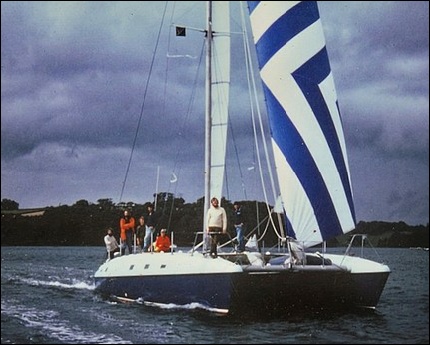 From the start, Boanerges was meant to stay independent, at anchor or moored and in the mud, without external dependencies. And relatively light. She still has no built-
With me, a transformation started. For the first 4 years, I used her as is. The first trip in 2002 was from Amsterdam to the Scillys with friends who had little children. Boanerges proved to be a sturdy and friendly Go-
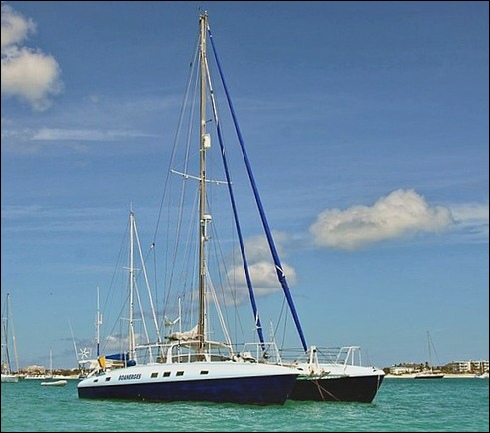 Technically she is after 24 years the same boat, with no alterations underwater, the beams are structurally not altered, with 3 cockpits and a trampoline in the front. She sails as safe as ever. The outboard engines and black water tanks serve well. (a watermaker is added) The main development is that I added first a low soft-
In Amsterdam, I had installed an electric Anderson winch for all the pulling and all sorts of hoisting and pulling and added a Quick Hector anchor winch, sturdy, simple Robertson/Simrad autopilots on both sides. And a Schenker a watermaker was installed with Solara flexible solar panels. Both appeared to be a mistake. I left with a PVC dinghy, which was too a mistake.
At St.Martin, the problematic Schenker was converted into a Spectra. No problems since then. Too, computer-
Actually, except for the Andersen and Quick winches, most of the investments were lost money. I could not anticipate tropical conditions, like most other novice long-
The boat is dependent on battery charging these days, like most other boats. It was my constant effort to keep that electricity circuit up and running.
30 years ago a common setup was an Aquair tow generator, which produced a lousy 1 AH, a wind generator with a big output, but dangerous and prone to malfunction, some small solar cells, and lead acid batteries. Power saving was a must. And corrosion was a big spoiler. After 3 cheap Chinese generators, a Honda gasoline generator was needed as spare.
In 2010 I mounted reliable big solar panels on the hardtop. The KISS wind generator gave a lot of energy when the boat was moving. And it too generated a lot of trouble. However I was able to generate 3AH continuously. But with worries. The autopilot worked continuously. Over the day, with the sun, the watermaker made 20L/hour. After 15 years in the tropics these items need to be renewed.
Today, in 2024, I expect wind and gasoline generators to be no longer needed in some years. In the tropics, solar power will do the job. The electronics for charging have enormously improved. But corrosion from damp, hot, and salty air is still a big problem, together with fading LCD screens in all sorts.
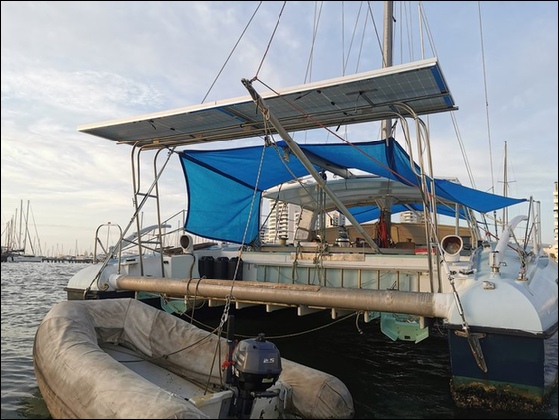 I expect the next 20 years should be used to convert Boanerges to electricity operated, while using the same trustworthy Yamaha 9.9HT auxiliary outboards as spares. Technically it should be simple to install a used 7Kw electric car motor, under the mast beam on a pivoting axis. 4Kw gives a cruising speed of 4Kn, without wind or current, and 6.5 maximum with 7Kw. The propellor is lifted out of the water when sailing.
The boat can accommodate about +/-
Energy is these days no problem with a powerful 24V/48V solar energy system. So the watermaker can do the work. Until corrosion comes into play. Toby Richardson, the builder, and I have used the boat in very rough environments. Everything breaks down in these harsh marine environments, especially electronics. So every breakdown has to be solved by the crew. After every breakdown, I looked for a simpler solution to avoid dependence on electronics. (by the way, I am a fan of electronics, the boat has a wide collection of them)
One has to find a workaround until one is in a place where proper repair is available. That can easily be 500NM away. And even then the right spare parts are very often not available. So the boat is loaded with backups and special spare parts.
This boat is not for someone who is used to sailing to a well-
The new owner does not need extensive knowledge of boatbuilding/repair or be a great sailor but does need to have a sense of technique and problem-