|
|
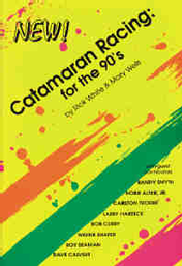
Catamaran Racing for the 90’s by Rick White and Mary Wells
(reviewed by Bruce Blalock)
Reading the book on cat racing was like bumping into an old friend: There’s so much that’s
familiar, but new wrinkles have been added. It starts up with the basics, as did the Rick White book of the 80s with which we’ve all grown comfortable. This work expands the horizon and adds specific suggestions about individual classes. Of added interest to me were the guest contributors’ sections, which let prominent racers from different classes discuss the boat with which they’re most familiar. It was a look at the course through the eyes, and over the crossbeams, of the big names in our sport.
As in almost any joint effort, there are a few errors. Fortunately, these are minor and have little effect on the quality of the publication. At the time of publication, the most obvious errors related to the Tornado. The International Tornado Association had not voted to increase the sail area, nor allowed double trapezing. Flying a hull on downwind legs was developed by the Australians, and was subsequently demonstrated by Mitch Booth and John Forbes in a very convincing manner with their 1989 World Championship win.
One chapter, called “Revival” (written by Mary Wells), seemed to me to be the heart-and-soul of all that we like about competitive sailing. It provided many suggestions as to how to interest people in sailing, and then in racing. Our sport has been in a decline for the recent few years. Eventually, this could prove fatal if not turned around. The most accurate statement in the book came from this chapter: “going fast and winning races is only important when there are other people to race against.” Not only were the suggestions important, but the attitude portrayed in this chapter is one that, hopefully, will catch on. It must, to insure the catamaran-racing community a future for everyone who cares to participate.
The book begins with basic boat-handling, and takes the reader through everything from weight distribution to sail trim. Then the real meat of the matter gets served: how to plan and organize a race and a regatta. It covers basic tactics and strategies of each leg of the course, as well as the start and finish. There are helpful “Notes to the Crew” scattered throughout the book which help to focus the attention of the forward person on the boat. (I believe that the crew is the real secret to a competitive boat.) These provide some useful insights into the management of the race and the ongoing concerns of the competitors.
In addition to the chapters on specific class boat hints, there’s a chapter on weather. So many times the speed of the competitors is so similar that the best way to gain any advantage is to be better able to predict weather changes, which requires recognizing/understanding weather conditions. This is an especially enjoyable section which should stimulate more research. The book is easy to read, interesting, and loaded with good information for the advancing competitor.
#296 Softcover, 6" x 9", 337 pp, graphs …Eur 39,95
|
|
|
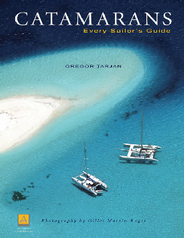
CATAMARANS, Every Sailor’s Guide by Gregor Tarjan
The title says it all. You don’t have to be a catamaran sailor to enjoy this book.
Author Gregor Tarjan has done an incredibly great job in conceiving and putting together this “Technical Coffee Table Book.” Yes, I know that this description is an oxymoron, but it is true: the book has lots of solid technical information, decorated by some of the most beautiful catamaran photographs I have ever seen, by famed French photographer Gilles Martin-Raget.
This 300-page book has four major parts:
1. MULTIHULL CHARACTERISTICS: dealing with Multihull Advantages; Desirable Attributes; and Critical Issues.
2. MULTIHULL PARAMETERS: Design & Dynamics; Evaluation & Coefficients; Hull; Appendages; Rig; and Construction.
3. MULTIHULL SEAMANSHIP: Sail Handling, Monohull vs. Multihull; The Magic of Apparent Wind; Maneuvers Under Sail; Docking & Under Power; Anchoring; and Heavy Weather Tactics.
4. NOTEWORTHY MULTIHULLS: Twenty-one different boats, by all means only a fraction of the total in existence, are shown but not evaluated (that would take many volumes).
The book starts out with Acknowledgements, a Foreword, Introductions, History and a description of Present Environment; and ends with Appendix 1-5; a Bibliography & References; Glossary of Terms, and a very comprehensive Index.
Each Chapter starts with an incredible, two-page spread photograph. There are many full-page pictures of different boats, boat parts, accommodations, sails and rigs, as well as graphs and drawings to supplement the text that they illustrate. One of the many drawings shows the advantages of why multihulls benefit from tacking downwind instead of sailing the way monohulls do. Another illustration compares the different multihull hull shapes and the different wetted surfaces at the same displacement. Instead of spending pages and pages here to describe all the information in this book and still fall short of its value, we strongly suggest to put one on your coffee table (after you’ve read it), on your book shelf and, perhaps, also one in your boat’s library to show off to your visitors.
It is truly a wonderful catamaran book, long awaited (and overdue), that no sailor should be without.
#101 – CATAMARANS, Every Sailor’s Guide, by Gregor Tarjan, 300 pages, hardcover
………Eur 48.95
|
|

|
Chasing The Dream by Val Haigh
(review by circumnavigator Rory McDougall)
Chasing The Dream is a delightful story of the Haigh family relationships and adventures whilst circling the world on their 40-foot Hedley Nicol trimaran. Although set in the late 60s and early 70s, their tales of cruising have similar principles in modern day. Val and Ernest should be hailed as pioneers, sailing their trimaran Tryste so far, when those early designs were largely experimental. Chasing The Dream is not a technical account of the Tryste’s world voyage, but rather an interpersonal account of how Val, Ernest and their four daughters adapted to a new life afloat; making the most of the places and people they visited en route. Val’s words successfully bring each landfall to life and conjure up aromas of tropical isles.
This is a ‘must read’ for all cruising sailors, especially those who are taking their own family voyaging. Val passes on many lessons learned and tips for others wishing to live on the high seas. The last few chapters will also satisfy “adventure book junkies,” when Val and Ernest pit themselves to save Tryste from disaster, losing a float and mainmast amidst the vast North Pacific. Their account highlights the determined nature of these two avid cruisers. This is one of those books that when finished one thinks: “Why aren’t we all out there chasing the dream?” I really liked the book once I got into the first few chapters, it was 227 pages of good reading!
#223 Softcover, b&w photos, 227 pp …Eur 21,20
|
|
|
The Complete Book of Anchoring and Mooring by Earl Hinz
(reviewed by Richard C. Newick)
If ground tackle ever becomes as expensive as an insurance policy, we’re in trouble. Meanwhile, good anchors are our best insurance against disaster, as long as they’re properly placed and connected to the vessel with enough of the right stuff, whether metallic or synthetic. One fellow tells how he survived a 122-knot Tahitian hurricane with 6' waves in the anchorage. He chafed through one rode; the second held, and he had 3 more in reserve. How many people cruise with 5 anchors? The smart ones do. They have successful, happy cruises.
The design of deck gear for anchoring, to minimize chafe and provide enough strength, hasn’t yet been perfected, but Mr. Hinz gives us today’s best choices. His section on preferred thimbles for rope storm anchors is excellent. This reviewer has seen too many of the usual pressed-metal teardrop-shaped thimbles ‘upset,’ sawing through otherwise strong nylon rode. At last, better choices are available, but aren’t yet well known enough.
We’d like copies of the chapter on rights, responsibilities and etiquette aboard, to hand to some drifters who drop toy anchors near us. In fact, we would like to know that every vessel in the harbor is under the command of a seaman who knows and understands this book. “I’m sorry” is a somewhat useless phrase when shouted above a screaming squall, as a boat drags through the harbor, taking properly moored vessels with her.
#119 Hardcover, 6" x 91/2", 309 pp, graphs, tables, photos, drawings, index ....… Eur 35,55
|
|
|
The Complete Loran-C Handbook by Luke Melton
With the prices of Loran-C receivers decreasing each year while their capabilities and dependability increase, more and more American yachtsmen and commercial navigators are buying units. Often, the operators’ manuals are indecipherable, and as a result navigators seldom utilize their receivers’ full potential. Most learn enough to turn the units on and find their approximate position, but they don’t know how to use a linear interpolator or loran plotter to locate themselves between printed time difference lines on a chart, and therefore they never attain the true accuracy the system is capable of. They know that flashing lights indicate a malfunction, but they probably don’t know what the problem is or how to correct it. They forfeit the impressive array of navigational functions that most loran units offer.
Without a great deal of effort, you can learn to play your receiver like a maestro. By programming waypoints, you can lay out a route in advance, and the receiver’s microprocessor circuitry will maintain a continuous running fix, informing you when you wander off course and how to return to it, and continuously updating your estimated time of arrival. You can get readouts of speed over the bottom and through the water, and a compass course to steer, adjusted for variation and ship’s deviation. In the outer geographic fringes of the loran signal coverage, you can manually override the receiver’s minimum signal-to-nose ratio threshold to receive fixes where otherwise you could not, a tremendously useful capability in places like the Bahamas. Melton also covers installation procedures, detailing the critical steps of antenna placement, electrical grounding, and location of on-board interference sources.
Luke Melton has taught coastal, celestial, and electronic navigation for many years, and it shows. This book is organized and written from a teacher’s perspective, logically and clearly, with your questions anticipated at every turn. If you want to get more out of your Loran-C receiver, here’s how.
#120 Softcover, 6" x 9", 222pp …Eur 19,95
|
|
|
Cooking On the Go by Janet Groene
Meals on a boat with tight space often are as dismal and dreary as North Atlantic fog. Now they needn’t be – even if the ship’s galley has only one pot and a larder filled with mostly canned goods. A seasoned veteran at making culinary silk purses from sows’ ears, Janet Groene brings years of stove-top and iceless enlightenment to breakfast, lunch and dinner tables, not only for cruising/racing boats, but for RVs and tent encampments.
In foolproof, easy-to-follow fashion, she concocts such crew-inspiring dishes as: Jury-Rigged Eggs Benedict, Burgoo for 15, Chick-pea Meatballs, Beer Fondue, Power’s Out Macaroni, All-at-Sea Ratatouille, Pumpkin Soup, Ambrosia, Depression Cake, Sunshine Pudding, and, for deep post-prandial satisfaction, Sampson Cay Smash.
Miraculously, all of these are made from simple provisions stored without refrigeration. As if such elixirs and mixtures weren’t enough to change a same-old-thing voyage into a cook’s tour of hearty appetites, this book also teaches other ingenious galley tips: how to perform ovenless baking, how to use a pressure cooker for fast, energy-conserving 1-burner cooking, how to pre-cook at home, how to stow & grow fresh vegetables, and how to propagate yeast. Until now, a galley chef was considered little more than a human can opener...
#140 Softcover, 5 1/2” x 8”, 285pp .......…was: $18.95 … NOW: Eur 11,20
|
|
|
|
|
|
Cruising Catamaran Communiqué By Charles E. Kanter AMS®
Cruising Catamaran Communiqué is the latest book from the pen of Charles E. Kanter AMS®. It begins where his record-setting Cruising in Catamarans leaves off. Adding new introspection to older vessels and adding an entire new horizon to the newer vessels, Kanter reflects upon the global reach of the industry and his survey experiences with the burgeoning green (hybrid power) revolution.
The last decade ushered in a paradigm shift in yacht design, consumer demand, and government regulation. Kanter addresses much of that as he describes his experiences with various new offerings on the market. His surveyor’s mallet and critical eye provide you with a most readable, articulate text, punctuated with a myriad of diagrams and photographs.
The book theme of “virtues and vices” clearly states all sides to controversy both real and contrived. Handling large catamarans is well covered as is his penchant for appropriate anchoring technique for modern light-displacement vessels and catamarans based upon his personal professional research as well as research from other sources. There is a huge bibliography and a glossary worthy of a book in its own right. Know before you go may be a common cliché, but Kanter explains how you can evaluate a boat, no matter how many hulls it has, for your own purposes.
Kanter, or “Chuck” as his friends address him, began his sailing life back in the 1960s on Chesapeake Bay. By 1970 his avocation and enthusiasm for sailing, and a career move to Long Island, New York, introduced him to multihull guru Bill Symons. He quickly became a part-time make-ready and delivery specialist for Symons. By 1980, Chuck left his executive “day job” as a Training Director to work full-time at his passion: sailing! He became a delivery skipper, charter operator, sailing instructor, race chairman and yacht surveyor. Chuck did professional equipment testing and numerous boat and book reviews. The 1990s saw him as a full professional with portfolio. He is a SAMS Accredited Marine Surveyor, member of The Society of Marine Architects and Marine Engineers (SNAME) member of BOAT/US Exchange for Marine Professionals, has a USCG-100-ton license with Sail endorsement.
Cruising Catamaran Communiqué was formally introduced to the sailing public at the Strictly Sail International Boat Show at Oakland, CA on April 18, 2007
#470 – Cruising Catamaran Communiqué, by Charles E. Kanter AMS®, 416 pgs, 8.5 x 11, Perfect bound... Eur 37,50
|
|
|
Cruising is Contagious by Charles E. and Corinne C. Kanter
(reviewed by Charles K. Chiodi)
As they say, the third time is a charm. Two previous attempts by the Kanters didn’t make our book list, but “Cruising is Contagious” has enough merits so that we can recommend it. Their casual style of describing the carefree cruising that they have done over the years make for entertaining reading, with an occasional lesson learned by neophytes (Webster describes as beginners), and by frugaphiles (a word invented by Kanter), meaning frugal cruisers.
The book is fascinating enough that it is hard to put down even for a seasoned reader and critique writer as myself, which should sell a lot of copies. And if they do, the authors may be able to hire an editor and a proofreader for the next edition, for this first attempt, as good as it is in storytelling, it is burdened with wrong punctuation, misspellings (don’t ever rely on a spell checker on your computer) and, frankly, the book could use a good editorial going-over.
Now that I’ve got all the negative impressions out of my system, let’s read about what’s good in the book.
First, Chuck does a good job poking fun at himself, which makes the stories more believable and the author more humble, a virtue seldom found nowadays. Although the chapters jump around a bit, after a paragraph or two, you get right back into the groove and realize who is writing: Chuck or Corinne.
Second, after you’ve finished reading this book, there is no doubt in your mind that multihulls are the only sensible vessels to go cruising in. The Kanters, admirably, didn’t brag about their own boat even though privately they are convinced that there is nothing better.
There is a lot you can learn about what makes a good, serviceable cruising boat: what you need, absolutely; what is nice to have; and what is absolutely not needed. Heed their advice. They have been trekking around the ICW and to the Bahamas on a regular basis, have crossed the Caribbean a few times, and know the ropes about how to live aboard comfortably and economically. They are the real “frugaphiles.” Even if you are not a liveaboard as the Kanters are, you live aboard for the duration of your cruise, which can be months.
There is a lot of humor in this book, which makes it so much more delightful – The Admiral Tizzie story, for instance, or Charlie the Tuna. The cartoons by Creighton Henry and the late Joe O’Brien are hilarious, but some of the photographs taken by the Kanters could easily have been enhanced on their computer for better printing quality.
Their trip to Cuba as journalists is enlightening. I just wish Chuck had left out his political analysis. Anyone who has never lived under communism has absolutely no idea about how to judge such regime. Even though I agree that the US Government’s attitude towards Cuba hurts the people, changing policies would support Castro, just what we don’t want to do. This book is not a political forum, so enjoy the multihull sailing wisdom Chuck and Corrine share with you. Considering what book prices are today, the cost of Cruising is Contagious is bearable.
#393 Softcover, 206 pp, b/w photos & illustrations .......…Eur 18,70
|
|
|
The Cruising Multihull by Chris White
(reviewed by Charles K. Chiodi)
A comprehensive book on the subject of multihulls, written by a multihull designer/sailor, addressing the newcomer as well as the seasoned multihull sailor! In his assessment of advantages and disadvantages of multiple hulls, White is quite honest: He calls a spade a spade, and he neither pulls nor throws punches - until he comes to the intolerable narrow-sightedness of some conventional sailors. To this reviewer’s delight, he takes on long-time multihull foe Donald Street when he writes: “Contrary to Donald Street’s opinion, all boats can be holed. Even the strongest have gone down from gaping wounds - remember the Titanic? A multihull can indeed be torn open by floating debris, but the boat won’t go to the bottom because of it.” He then goes on to explain why not. At the end of that paragraph he boldly, and quite convincingly, declares: “I have a challenge for Mr. Street. You drill a hole in the bottom of your boat and I’ll drill a hole in the bottom of mine, and we’ll go sailing – no patching allowed.”
White points to another misconception: multihulls “don’t point and they can’t tack.” Anybody who watched the 1988 America’s Cup races and saw Stars & Stripes out-point and out-tack KZ-I would also laugh at this kind of statement.
The book is primarily written for sailors who want to go cruising on a multihull. Chapters on Trimarans and another on Catamarans explain the pros and cons of each. Subsequent chapters reveal the methods of Resisting Leeway, the peculiarities of multihull Rudders and Steering: Rigs; and Auxiliary Power.
Since multihulls are designed and built differently from monohulls, it is quite appropriate that White has a chapter on Specifics of Multihull Construction. In Appendix A, he provides a Catalog of Production Multihulls.
Although there are quite a few illustrations of his own boats, and two of his own designs are featured in Appendix C, Chris White is fair in mentioning other designers and their creations, and providing a list that is complete with addresses of best-known multihull designers worldwide (in Appendix B).
When it comes to the subject of capsize, the author is quite candid about it. Nothing is hidden or avoided. He approaches the subject from the different causes of wind capsize vs. wave capsize, and has suggestions for how to avoid them. Reading his explanations and convictions is confidence-inspiring, to say the least.
He addresses the capsize aftermath in real life, and has advice on how to right a capsized multihull. Other multihull seamanship chapters are on man-overboard recovery, safety nets, routine anchoring, and the use of the parachute anchor in survival conditions.
The Cruising Multihull is the best book written to date for people new to this type of sailboat and for those who want to have one of their own. White’s guidelines on ‘how to select your multihull’ are found in a chapter that starts out with the question: “What Kind of Cruiser Are You?” It is the intelligent way to select a boat, because there is wisdom in his words: “Cruising means different things to different people.”
Some sailors get more seasick than others, so there is a chapter on why fewer people get sick aboard multis. Some people want to build their own boat, while others want to buy one from a factory. The differences are well presented in a segment titled: Judging Production Boat Quality.
And, if you are still not sure… there is a very convincing chapter titled: Why A Multihull?
#311 Softcover, 7" x 10", 267pp, photos and line drawings …Eur 27,50
|
|
|
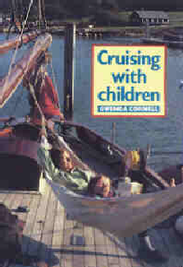
Cruising with Children by Gwenda Cornell
Sailing is one way to help a child depend on himself, and to teach him respect for the power of nature. There are problems and worries in taking children to sea, but they can be overcome by careful planning.
Children aboard a cruising yacht often become bored and are unable to cope with the environmental confines of life afloat. Parents, too, can have a cruise ruined by concern for family safety and how to occupy youthful energy. Cruising With Children contains practical advice on many problems that coastal or deep-sea cruising parents encounter with children of all ages.
The book details the benefits to be gained by sailing as a family, safety at sea, and health aspects, which are likely to be encountered. Projects and crew duties are suggested for long and short voyages, while particular mention is made of the care of babies and infants.
The Author: Gwenda Cornell holds a first-class honors degree in pharmacy from London University and worked in medical research as a pharmacologist. Later, she earned the post-graduate certificate of education. She taught her two children (5 and 7 years old at the outset) during a 6-year-long circumnavigation with husband, Jimmy; and successfully reintegrated the children into the educational system on their return.
#339 Softcover, 6" x 9", 110 pp, many photos & illustrations …Eur 20,75
|


