|
|
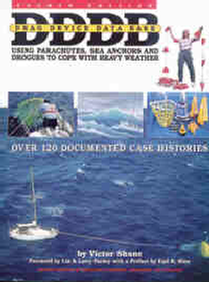
DDDB Drag Device Data Base – 4th Edition
by Victor Shane
This is a book dealing with offshore safety. Victor Shane’s interest in drag devices stems from three experiences he had in 1976 in the Santa Barbara Channel where he was sailing his 24' trimaran. When the wind came up suddenly, he was lucky enough to be able to tie the boat to deep-water moorings. The immense feeling of relief he experienced once the boat was secured and safe started him fantasizing: “Wouldn’t it be great if the Coast Guard built a grid of deepwater moorings all over the oceans?” As he knew that this wasn’t about to happen, his thoughts moved on to a portable mooring, i.e., a sea anchor. When his trial of a cone-type sea anchor did not produce the desired result, a friend suggested that he use a parachute. He bought a 9'-diameter ‘drop chute’ from a surplus store, put a swivel on the terminal and, when he tried it… the three bows came right up into the wind. He was sold!
After many years and passages, Mr. Shane is doing a good job of spreading the word about the usefulness of this safety device to other offshore sailors.
DDDB (which stands for Drag Device Data Base) has the purpose of documenting, cataloging, and publishing accurate information about sea anchors and drogues. It is in its fourth edition, it has been completely revised. The book has seven sections:
1. Heavy Weather Tactics Reviewed: After Fastnet ’79;
2. Sea Anchors used off the Bow;
3. Drogues used off the Stern;
4. Evolution of the Drag Device Data Base;
5. Fifty Documented Case Histories;
6. Preliminary Analysis & Lessons Learned: Sea Anchors; and
7. Preliminary Analysis & Lessons Learned: Drogues.
Theory is kept to a minimum and the pages are filled with graphics and computer illustrations. The documented case histories are divided into 7 sub-sections: 4 are about the use of sea anchors off the bow (for monohulls, trimarans, catamarans, and power vessels); the rest are about using drogues off the stern (monohulls, trimarans, and catamarans).
From the section on the use of sea anchors for trimarans comes this endorsement from the 42' Cross design, Gold Eagle: “My sea parachute is one of the few items I bought which performed as advertised and had no defect or surprises..” From the catamaran Catherine Estelle, (36' Kelsall): “The sea anchor definitely saved the boat and, I’m sure, our lives.”
Our own Seamanship Columnist, Earl Hinz, writes this:
“The Fourth Edition is a fine book which I can highly recommend to blue-water sailors who want to buy real insurance, and not simply the kind printed on paper.” The book has lists of: other books to read; route forecasters; producers of drag devices; hardware ratings; chain and rope strengths, meteorological events; offshore checklist; multihull capsize protocol, and much more.
#372 Softcover, 8 1/2" x 11", 196 pp, illustrations, index, appendix of producers of drag devices …Eur 39,95
|
|
|
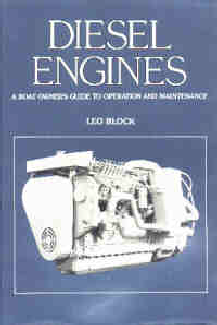
Diesel Engines A Boatowner’s Guide to Operation and Maintenance
by Leo Block, P.E.
If the owner of a diesel engine wants it to run smoothly, efficiently, and reliably, and wishes to minimize expensive repairs, then proper operation and maintenance are essential. This book focuses on those all-important areas, except repairs and overhauls which the average owner can’t, doesn’t want to do, or shouldn’t tackle anyway.
The first chapter presents a non-technical overview of fundamental diesel operating principles, and identifies the separate systems (cooling, fuel, etc...) whose dependable operation is requisite to good performance.
In subsequent chapters, each of these systems is explained, and the required maintenance tasks are presented in checklist format. Safety precautions are stressed and explained. A separate chapter is devoted to engine operation: warm-up, normal running mode, and shutdown. The appendices include such subjects as winter shutdown, what to expect from an engine survey, and troubleshooting.
Numerous illustrations and step-by-step instructions are all part of the author’s clear, well-organized presentation. The boatowner need not be an experienced mechanic to perform routine maintenance chores – and special tools are not required.
#327 Softcover, 6" x 9", 136pp, many illustrations …14,95
|
|
|
Emergency Navigation
by David Burch
This is a detailed account of how to find your position anywhere on the world’s oceans after your electronics fail and you lose your sextant, watch, and almanac, but that’s really only the beginning. The book is chock-full of good sound navigational techniques and principles that will serve you well regardless of where and under what conditions you are sailing.
Burch presents detailed discussions on finding time and place at sea; determining direction; steering by the wind and swells; steering by the stars; steering by the sun; and steering by other objects in the sky. You will also find chapters on steering under conditions of reduced visibility; piloting in currents; dead reckoning; latitude and longitude; and no instrument piloting. A final summary tells you what to do in any situation with what you have available at the time.
#130 Softcover, 7” x 10”, 248pp, many illustrations, charts, and diagrams …Eur 21,20
|
|
|
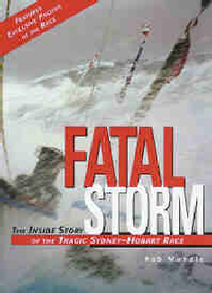
Fatal Storm The inside story of the tragic Sydney-Hobart Race
by Rob Mundle
The sailors aboard the one-hundred-and-fifteen boats in the Tasman Sea were prepared for ordinary gales, but what Nature dealt out was anything but ordinary...
The annual race from Sydney, Australia, to Hobart, Tasmania, is one of the world’s three great ocean-racing events. The 630-mile course takes competitors across the notorious-ly rough waters of the Bass Strait and the Tasman Sea.
A freak, unseasonal storm in the pre-dawn hours of December 27, 1998 brought hurricane-force winds, waves six stories high, and the worst sailing disaster in recent history. Seven boats were abandoned and five of those sank. Fifty-seven sailors were rescued, but six were lost.“Mundle’s portrayals of courageous sailors and heroic rescuers fighting for their lives are as vivid as any I have read.” John Rousmaniere, author of Fastnet,Force10.
Here is a story only Rob Mundle could have written. An Australian journalist, and sailor who has covered the Sydney-Hobart Race 30 times (and participated in it trice), Mundle knew many of the participants. He knew the rescuers. He interviewed 124 survivors, family members, rescuers and race officials.
He reported the unfolding drama on Australian television. The images in this book will haunt you: what is it like to be trapped beneath an overturned sailboat in the height of the storm? The bewilderment and disbelief when the ocean cracks open the deck beneath which you huddle and starts pouring in!
Skillfully interwoven by Mundle, the firsthand accounts of the storm are vivid and unforgettable. The scream of the wind, the roar of the waves, the last sight of a crewmember floating face down while his boat is swept away... It is a story of the awesome power of the sea.
#390 Hardcover, 6” x 9-1/2”, exclusive color photos, b&w map …Eur 27,20
|
|
|
Fiberglass Boatbuilding for Amateurs
by Ken Hankinson, N.A.
This is a ‘must’ book for anyone contemplating the construction of a fiberglass boat, or for those who simply want to learn about the subject. It is practical, ‘how-to’, especially written for the beginner. Yet, it’s also ideal for the more experienced who wish to branch out into the field of fiberglass construction.
The book covers all aspects of fiberglass boat construction, with emphasis on the proven, practical methods suited to the amateur or limited-production professional. It tells how to build your own fiberglass boat by using cost- and labor-saving methods, while avoiding common pitfalls. By following the easy-to-read and understand text, you can make your boat equal or superior to one made in a factory.
It was written in non-technical language by a naval architect who has specialized in boat design for amateurs for nearly 20 years.
Some of the subjects are: how to make parts & components from fiberglass; complete details for hull & deck construction using the latest materials & processes, including C-Flex fiberglass planking, Ferro-Glass and str-r-etch mesh, Airex & other non-cross-linked PVC foams and endgrain balsa core; how to use the new high-modulus materials & specialty reinforcements, including S-Glass, Kevlar, carbon fiber, aerospace unidirectionals, biaxial and triaxial fabrics; sandwich core materials and principles in female- and male-molded hulls; paints & coating application techniques.
#133 Hardcover, 8 1/2” x 11 1/4”, 392pp, indexed, appendices & bibliography, many photos, drawings, illustrations, charts and graphs …Eur 44,95
|


