|

|
The Magic of Dolphins by Dr. Horace Dobbs
There has existed an extra-special relationship between dolphin and man from the earliest times on.
One reason for this is the dolphin’s love of fun and companionship. They enjoy the company of humans, diving beneath people while they are swimming, riding the bow waves of boats, and even piloting them through difficult waters.
The other significant factor is the dolphin’s remarkable intelligence. Dr. Horace Dobbs describes some amazing encounters with dolphins in the wild, and demonstrates that the dolphin not only lives at peace in his habitat, but can bring happiness to humans. Dr. Dobbs, one of Britain’s pioneers of underwater photography, founded The Oxford University Research Group in 1963. He is also founder and director of International Dolphin Watch. Although a Fellow of the Royal Society of Medicine, he gave up a career in medical and veterinary research in order to devote his life to his passion for dolphins.
#309 Softcover, 6 1/2" x 8 1/2", 88pp, many color and b&w photos ....…Eur 12,50
|
|
|
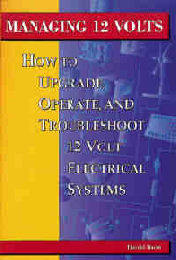
Managing 12 Volts –
How to Upgrade, Operate, and Troubleshoot 12 Volt Electrical Systems
by Harold Barre
Do your batteries fail to power the electrical devices on your RV or boat? Do your chargers fail to recharge your batteries adequately? Are you frustrated with your 12-volt electrical system?
Managing 12 Volts solves your electrical problems.
You will learn how easy it is to:
Upgrade your system by answering three simple questions, and by installing the equipment to support your answers, you will have all the electrical power you need.
Operate your electrical system by learning how to determine the amount of “fuel” your batteries contain, and how to recharge them properly.
Troubleshoot your 12-volt electrical system by following simple step-by-step procedures for troubleshooting circuits containing failed lights, electronics, chargers, or batteries.
The book includes the concise treatment of how to Determine Your Electrical Requirements (Chapter 2), and Determine Your Battery Capacity (Chapter 3). The author stresses that batteries are the heart of any 12-volt system and emphasizes the importance of monitoring and maintaining proper battery condition, a must for keeping your power system in balance. There is also a clear explanation of Understanding Electrical Circuits (Chapter 8) and Troubleshooting Electrical Circuits (Chapter 9), enhanced by numerous simplified wiring schematics. Additional subjects covered in the book are Types of Lead Acid Batteries; Battery Charging; Monitors, Wiring & Switches; and Designing and Operating Your 12-Volt System.
#253 Softcover, schematic drawings, 212 pp .....…Eur 24,95
|
|
|
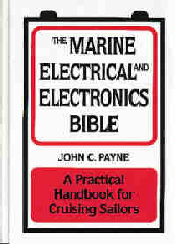
The Marine Electrical and Electronics Bible –
A Practical Handbook for Cruising Sailors – 2nd Edition
by John C. Payne
With the enormous increase in the use of electronic and electrical equipment, mariners are hard-put to keep up with the necessary installation procedures, nor are they aware of the required troubleshooting. Now all this information can be found within the covers of this book. It’s a detailed guide for how to select, install, maintain and troubleshoot all the electrical and electronic systems on a boat.
This is a handy volume not only for professionals but also for the weekend cruiser or long-distance racers/cruisers. Remember there is no 24-hour road service station offshore!
This fully revised new edition has been expanded to cover the internet, e-mail, GMDSS, updated radio frequencies and much, much more. The clear concise text is supplemented with hundreds of informative charts, wiring diagrams and graphs.
#459 Hardcover, 7 1/4" x 10 1/4", 420pp, graphs, tables and explanatory drawings galore ......…Eur 41,95
|
|
|
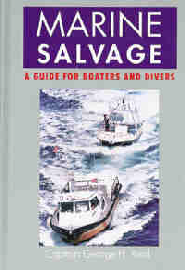
Marine Salvage A Guide for Boaters and Divers
by Captain George H. Reid
Why would multihullers be interested in such a book? Multihullers, more than anyone, should read this book – whether dismasted, somewhat holed, or even capsized... theirs are the very boats that can be salvaged.
Articles in MM's May/June 1996 issue bear witness to that. Rescued and/or salvaged were: Triad, Spirit of Ft. Lauderdale, Banque Populaire, Primagaz and the beautiful little Orion on the cover of that issue.
Yes, they also have to assume some costs for this service. Depending on what type of salvage was performed, these costs can vary. Still, it's better to pay a little something and get your boat back rather than the numerous monohulls that remain languishing and rotting on the bottom. The owners opt for pocketing the insurance money and leaving their "baby" to that abysmal fate. It could mean that they love their boats less – but, factually, such an operation would be more costly for them, resting 'deep' versus the stricken yacht that is floating upside down, sideways, whatever way... but floating.
Possibly the next nearest mental image people have when thinking 'salvage' is: retrieving sunken treasure. It's an exciting and even romantic thought, but whatever salvage that comes to mind, there are rules and regulations to be aware of. If you bring up some Spanish doubloons from a ship that you discovered... Can you keep some? Can you get a percentage? Probably not if you didn't know the right procedures and processes that should have been taken care of prior to bringing anything up.
What can be considered as a "salvage"? That can cover an array of different actions. If one yacht loses power or is dismasted, and another comes along offering a tow... and the tow is accepted and carried out successfully... will it cost anything? Who will set the fee? What if you don't agree on the fee, who ascertains what is a fair fee?
Regardless of what type of boater you are – this book does not only discuss many of such questions, it also tells you the answers or indicates where to find them.
# 241 Hardcover, 6" x 9 1/4", 160 pp, many b&w drawings …Eur 29,40
|
|
|
Multihull Cruising Fundamentals: |
the Official American Sailing Association Guide to Cruising Multihulls
by Rick White
"Multihulls" offer sailors expansive comfort, impressive speed, precise maneuverability, and, in the case of trailerables, easy storage and transportability. No wonder boat buyers and charter clients have begun migrating toward cats and tris in unprecedented numbers. "Multihull Cruising Fundamentals" taps into the essence of multihull sailing and gives readers a clear and concise analysis of these largely unfamiliar boats. Chapters one through four provide the skills sailors need to get trailerable multihulls safely into the water, rigged and sailing. Larger, cruising catamarans and their unique sailing and handling needs are addressed in chapters five through eight. The material in this book was developed by the American Sailing Association's Multihull Committee for use in classes throughout North America. Students will learn quickly and efficiently from "Multihull Cruising Fundamentals'" "no nonsense," step-by-step format. The knowledge and skills found in this text will prepare sailors to more fully enjoy the most forward-looking boats on today's pleasure boat market.
#645 Softcover, 11" x 8 1/2", 119 pages, drawings and B&W photos .....…Eur 17,50
|
|
|
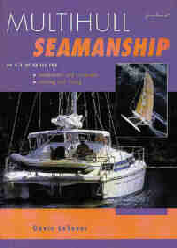
Multihull Seamanship Illustrated by Gavin LeSueur
“There are no hard and fast rules at sea. Sailing is an art.” This book is a bigger and better update from the original. There is a lot of expert input in this book from the vast sailing experiences of the author and his friends, Ian Johnston, Cathy Hawkins, Paul Nudd, Grant Telfer, Dean Snow, and others – all multihull sailors. The draft was edited by Lock Crowther, two weeks before he died from a massive heart attack.
Although the subject matter is serious (and educational) the illustrations by Nigel Allison are quite humorous, sort of cartoon-like. The chapters are arranged in alphabetical order: Anchoring, Apparent Wind, Battens, Beaching, Bridles, Capsize & Waves, Capsize & Sheet System, Capsize & Reefing System, Capsize Preparations, Capsize Survival Tactics, Cargo, Centerboards, Collision, Crew & Passengers, Cyclones, Dinghy, Dismasting, Electricity, Fire & Gas, Flares & Torches, In Irons, Jetty Work, Life Rafts, Man Overboard, Masts, Motors, Racing Seamanship, Radar & Reflectors, Rigging, Righting, Roller Furling, Sails, Self-steering & Autopilots, Seaweed & fishnets, Sheet Systems, Sinking, Slipping, Spinnakers, Steering & Rudders, Storm Sailing, Stress Measurement & Beam Failure, Telltales, Towing, Trailering, Trampolines, & Safety Nets, Trans- fers, Whales. There are 40+categories in all.
At the end of the book is a Glossary of Terms, and an Index.
The author is qualified by his own experiences during the loss of his catamaran D-Flawless during a severe storm off the Australian coast.
#154 Softcover, 11 3/4" x 8 1/4", 144 pp …Eur 27,65
|
|
|
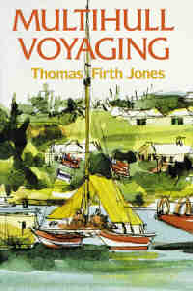
Multihull Voyaging by Thomas Firth Jones
Thomas Firth Jones is a long-time contributor to MULTIHULLS. Starting with the Spring issue of 1977, he has written several accounts of his sailing/cruising, designing and boatbuilding skills. He is, what you would call, the down-to-earth designer/builder who believes in the make-it-simple have-no-trouble principle.
Most sailors dream of owning an affordable family-style cruising boat that is safe and easy to handle. In this book Tom Jones shows how to make this dream come true by buying or building a small or medium-sized cruising multihull. It is an important book that explains why multihull voyaging is becoming more and more popular.
Here is an excerpt from just one of his chapters:
“I do not trust a boat with a keel in bad weather out on the ocean. I’ve never tried one, but in the accounts of knockdowns – both of multihulls and monohulls – when the skipper has been prudent and the boat is snugged down for the blow, almost always there is a sideways tripping. A wave hits the boat, and she trips and goes over. What she trips on is the keel. A hundred years ago, sailors of coastal freighting schooners learned to trust the centerboards in really bad weather, and to mistrust the keelers.
“Dozens of times, I’ve been in the cabin of one of the multihulls, in a gale or storm or hurricane, and a wave of 20 or more feet height has hit the boat. The boat skips away from it so fast that I am plastered against the seatback of the planking. What would have happened with a keel down deep in the water? A fixed keel is a tremendous help to a monohull, because it can carry the ballast, which is more effective when lower. It has no comparable advantage in a multihull, and I do not advise it.”
#445 Hardcover, 9 1/4" x 6", 202 pages, drawings and B&W photos …Eur 27,20
|


