|

|
Rescue in the Pacific – A Riveting Tale of Rescue on the High Seas
by Tony Farrington
In June of 1994, a dramatic story of life, death, and the epic struggle of man against the forces of nature unfolded in the South Pacific. North of New Zealand, a powerful Force 12 storm developed and, with little warning, swallowed up a fleet of yachts, launching one of the most Herculean rescue missions in recent memory.
As Tony Farrington’s narrative begins, yachts bearing sailors from America, Australia, and New Zealand are overtaken by a sudden storm with winds of 70-90 knots and waves of up to 100 feet. What follows is a story as spellbinding and harrowing as any novel. As the yachts’ crews fight desperately to survive the storm, a valiant rescue operation is undertaken by an international fleet of merchant, naval, and fishing vessels – against incredible odds.
Farrington, who only through sheer luck escaped being caught at sea during the storm, interviewed survivors and rescuers. Besides these first-person accounts, the book contains spectacular photos, many taken from vessels in the belly of the beast – which vividly depict the storm’s fury.
When it was over, three people had disappeared and 21 had been rescued, plucked from their boats at the height of the storm. Both survivors and rescuers were forever altered by the experience, and the book explores that side of the story as well.
Finally, the epilogue reveals the survivors’ thoughts after the storm, including analyses of how their actions effected the eventual outcome. Of further interest, an appendix with weather maps discusses storm conditions from a meteorological point of view.
About the author: Accomplished sailor Tony Farrington (Auckland, New Zealand) has been around the sea most of his life. He runs a successful public relations and advertising company. Only a last-minute business delay prevented him from putting to sea just before the storm, which he then followed from his boat’s radio station while moored safely in port.
#193 Hardcover, 5 1/2" x 8 1/2," 273 pp, b&w photos …Eur 16,25
|
|
|
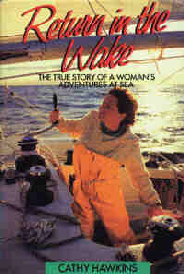
Return in the Wake – The True Story of a Woman’s Adventures at Sea
by Cathy Hawkins
To any would-be or actual single- or double-handed sailor, Cathy Hawkins’ book Return in the Wake is compulsory reading. Cathy describes her own book as “the story of a dream.” It relates her experiences with Ian Johnston and their two trimarans: little Twiggy and beautiful Balena.
These two sailors are probably the best-known Australians in the field of short-handed sailing. Cathy’s training as a journalist has enabled her to capture the mood of each moment. An example was the excitement of the Round Britain and Ireland Race. For them, the race ended in a dramatic capsize, described by Cathy as follows: “The top meter-and-a-half of the wave we had just surfed had broken, and foaming white water was biting at our stern. I looked ahead to find a way to avoid the wave’s impact but, in an instant, it had swooped in. I leaned forward to release the spinnaker.
“I couldn’t reach it. I was flying through the air, my arms back-pedaling to break my fall into the icy sea. At that moment I saw myself detached, in slow motion, like a figure in a film, staring at my bright yellow seaboots and tumbling towards the spinnaker lying flat upon the water. Twiggy’s bows were buried; she was standing on her nose.
“I hit the water and the mast splashed down next to me. A surge of adrenaline rushed through me as the disastrousness of our predicament penetrated.” From there, she recounts the events of salvage and the battle for sponsorship, culminating in Twiggy’s being entered into the single-handed La Route du Rhum with Ian Johnston as skipper. Again the effort resulted in an unfortunate capsize. At least the sponsor received publicity.
The book gives clear insight into the mettle of these two famous Australians who have, between them, clocked more than 12,000 sea miles. Following their early disasters, the book moves with them into the new era, recounting the building of Balena and the obtaining of sponsorship. With the new craft, they raced the Pacific while Cathy faced her ultimate aim of single-handed ocean passages. You feel you are with her as she battles with her ‘friend and ally,’ the sea.
“Nearly everything that could possibly happen at sea had happened to me, and I had not been afraid. But, this lonesome passage was different; I’d become afraid of being alone with my thoughts and fears. I’d wanted so badly to sail alone, but a voice inside me kept insisting that I shouldn’t be doing this.”
As Cathy tries, and tries again, you move with her, willing her to succeed.
Since writing the book, Hawkins and Johnston had sponsorship from Verbatim, the floppy computer-disk manufacturer. They stretched their unbeaten record to 32 victories before losing to Top Gun in 1987.
#280 Hardcover, 6 1/4" x 91/4", 188pp, color and b&w photos
....…was: $18.95 …NOW: ...... Eur 16,25
|
|
|
Sailing Drills How to Sail Better, Faster, Smarter, and Safer
by Rick White
Randy Smyth, Olympic Silver Medalist:
“The many mysteries that are discussed on the way home from regattas now have an answer. Rick White has virtually dissected the art of sailing into individual skills. By using time-tested, on-the-water drills, he has provided this book to elevate any sailor’s proficiency. I used these drills daily while preparing for my Silver Medal win in the 1992 Olympic campaign. Now, I’ve introduced the ’96 U.S. Olympic Team hopefuls to Rick’s methodology.
Thank you, Rick White.”
Eric Sharp, Detroit Free Press:
“In the course of 20 years of writing about sailing, I’ve met most of the world’s top skippers. I’ve also met a handful of sailors who don’t compete in high-profile events, like the America’s Cup or the Whitbread-Around-The-World Race, but whose skills are the equal of the famous guys.”
Rick White is one of these unheralded masters, a man best known for his exploits on multihulls, but who can climb aboard virtually anything with sails and get it from Point A to Point B faster than just about anybody else. He is also one of the world’s great sailing instructors. People who thought they were hotshot club racers come away from his seminars, after several days of intensive on-the-water drills, with some impressions:
First, they weren’t as hot as they had thought.
Second, they’ve learned a tremendous amount and are far better skippers than they were three or four days earlier.
Third, that the new knowledge is just the basics of what White knows. It would take virtually weeks to pass along all of his tricks.
That’s where Sailing Drills comes in. Distilled into 160 pages is the wisdom of years of experience, and in a form that will allow novice and expert skippers alike, to hone their skills through practice, practice, and more practice.
#468 Softcover, 6" x 9”, 160 pp …Eur 37,40
|
|

|
Sailing Promise – Around the World on a Catamaran
by Alayne Main
When Alayne Main agreed to sail around the world with her husband, she could only find blissful travelogues and macho how-to books. There weren’t any books that told her what it was really like; so she wrote her own book that explores much more than just the countries she visited.
She was 28 years old with an exciting medical career and minimal sailing experience, but she lived up to her sailing promise. She and her husband quit their jobs, bought a 33-foot Prout catamaran and blithely sailed away...
Only to find that the challenges were immense with the storms at sea and the physical hardships, a collision with a whale, and the threat of pirates, but the greatest challenge was the emotional turmoil that their adventurous and uncertain lifestyle created.
With her relationship deteriorating, Alayne was forced to deal with her fears and understand what drove her to continue sailing across vast and unpredictable oceans – with only her husband to turn to.
After four years, they came home circumnavigators – and still married.
#385 Softcover, 5 1/4" x 8 1/4", 296 pages; b&w and some color photographs …Eur 22,50
|
|
|
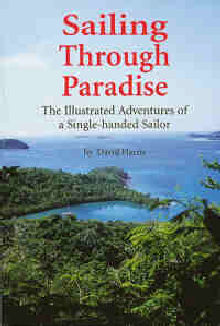
Sailing Through Paradise –
The Illustrated Adventures of a Single-Handed Sailor by David Harris
Eager for adventure on the high seas, David left his desk job to sail alone through the Caribbean on his 32-foot PDQ. In Sailing Through Paradise, Harris takes the reader along on his sometimes exhilarating, sometimes frightening cruise through the West Indies. His delightful writing style enlivens descriptions of his day-to-day experiences while sailing through the waters near:
• The Bahamas
• The Turks and Caicos
• Hispaniola
Those who are considering a similar trip will find the book informative.
It touches on topics of interest such as:
• planning a route
• anchoring and anchorages
• clearing customs
Cruisers who have traveled the Caribbean will enjoy revisiting many spectacular locations through the pages of this book, and for those who only dream of ocean adventure, Sailing Through Paradise is dedicated to you.
This book is beautifully illustrated with David Harris’ color photographs, and with maps of each leg of his voyage.
#387 Softcover, 6" x 9", 223 pages, many color photographs and maps
....…Eur 31,20
|
|
|
The Sailmaker’s Apprentice
by Emiliano Marino, Illustrated by Christine Erikson
With this book anyone can learn to design, make, repair, improve and maintain sails.
Chapters include the theory of sail shapes; how they are made; making your own; caring for and maintaining; repairing and restoring; and much more. The author is a long-time sailor and sailmaker with good advise on how to buy new and used sails; getting the most out of sails; trimming and adjustments; “hardware” and “software” of sails; and rigs and sails.
Black and white drawings illustrate tools of the trade as well as the details of how to make different sails. Tables show aspect ratio, proportions of selected sail types, cloth uses, reef point specifications, headboard sizes, and much more.
#288 Softcover, 480 pp …Eur 30,15
|
|
|
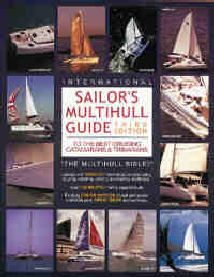
Sailor’s Multihull Guide – 3rd Edition
By Kevin Jeffrey, Charles Kanter, and Many More Contributors
“The Multihull Bible” is back, with a new updated version. With over 150 multihulls featured (66 sailing catamarans, 20 sailing trimarans, and 27 power cats) including its designer’s and builder’s information, this book proves to be a valuable source in a one-stop reference. Sections also include: Characteristics of a Cruising Multihull – Boat Classification, Cruising vs. Racing Multihulls, Good Cat/Bad Cat, Modern Concepts, Multihull Seaworthiness, Cruising Considerations; Chartering a Cruising Multihull – The Charter of Choice, Multihull Term Chartering; Getting Your Own Cruising Multihull – Buying a New Multihull, Buying a Used Multihull, Building a Multihull; Owning a Cruising Multihull – The Charter Management Option, Co-Ownership, A Marine Survey, Multihull Insurance; and Multihull Seamanship – Sailing a Cruising Multihull I, Sailing a Cruising Multihull II, Maneuvering Under Power
#424 Softcover, 488pp, …Eur 36,50 (2nd Edition: ... Eur 25,00)
|
|
|
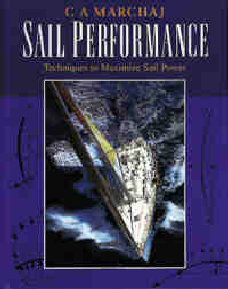
Sail-Performance: Techniques To Maximize Sail Power
by C.A. Marchaj (reviewed by Dick Newick)
Anyone with a long-standing serious interest in how and why boats sail fast is probably familiar with “Tony” Marchaj’s classic two previous books on the subject. They are big and expensive volumes, full of superb graphics, illustrations, photos and well-written text. This latest book has the same format, bringing the fortunate reader up to date on Marchaj’s research and interests since the publication of “Aero-Hydrodynamics of Sailing” in 1979, and a revised and expanded edition in 1988. Those books will not be obsolete for a long time, so sailors may be curious about how they could possibly be improved. At the same time, based on the quality of the author’s previous work, we can assume that whatever Marchaj has written about sailboats deserves study. As a young man, he was the Polish national champion in the Finn class. Much of his working life has been spent at Southampton University’s test tank and wind tunnel. This reviewer is leery of raw wind tunnel data interpreted by non-sailors who can be unaware of the major changes in wind direction of the masthead of sailboat on a rough sea. No problem here. Marchaj combines the practical background of a sailing champion with the latest theoretical research results from tank and wind tunnel. This book will help designers, builders, and sailors make boats more efficient and faster.
Multihull sailors will be especially pleased to see the results of theoretical and full-sized comparisons in Chapter 11 of six different small boat rigs. Bermuda sloop, Lateen, Sprit, Gunter, Dipping Lug and Crab Claw. Without the modern go-fast gadgetry available to racing sloop sailors, the research show that the crab claw rig as developed on Pacific island multihulls hundreds of years ago is the most efficient of those tested. Those old salts evolved a rig that benefited from the vortices it created. All the other rigs are less efficient because of vortex drag. They had more to teach us than simply the number of hulls they used to explore more than one fifth of the world’s surface.
Chapter headings in all of Marchaj’s books start with pertinent quotations from a wide variety of literature. For instance, Chapter 11 mentioned above, starts with this from Oscar Wilde: “It is always a silly thing to give advice, but to give good advice is absolutely fatal.” So this reviewer should only say how much he admires and relies on Marchaj’s work.
To start the chapter on sail trim, we have something written by Thomas Spratt in 1667. “So easy is the passage from one extreme to another, and so hard it is to stop in that little point wherein the right does consist.” Other quotes from Joseph Conrad, Lord Byron, Sophocles, Sir Arthur Conan Doyle, and others enliven the text.
The book is divided into three parts. 1. Yacht Evolution, rating formulae and speed performance. 2. Aerodynamics of sails, and 3. Steady and unsteady wind, plus four appendices, of which this reviewer found Reynold’s numbers and “scale effect” particularly helpful.
The technical subjects analyzed so well in this book are rendered understandably to readers without a mathematical education, largely because of the superb illustrations and graphs on almost every page, clearly related to the text. Sailors who concentrate more on what happens afloat than the design process will find part 3 “Steady and unsteady wind,” most helpful in racing or cruising situations.
In his Preface the author quotes Richard Feynman, Nobel Laureate physicist “... the test of all knowledge is experiment. Experiment is the sole judge of scientific truth.” We are fortunate that Marchaj has done so many important studies of boats, and has the ability to describe them well.
#252 Hardcover, 8” x 10 3/4”, 401 pp. b&w graphs, charts, formulas
...…Eur 68,70
|
|
|
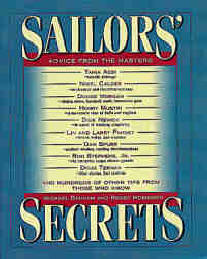
Sailor’s Secrets: Advice from the Masters
by Michael Badham and Robby Robinson
Sailors’ Secrets, offers the seagoing experience of its authors, Mike Badham and Robby Robinson, along with hundreds of contributors. The names listed sound like a “Who is Who in Sailing.” Most are so well-known they are household names for multihullers and monohullers.
The tips and suggestions range through virtually any imaginable topic associated with boats... you name it, and it’s likely to be in there.
Some references and snipped quotes come from works by such authors as: Jim Brown (The Case for the Cruising Trimaran), Steve Callahan (ADRIFT- 76 days lost at sea), Alain Colas (Around the World Alone), John Glennie (The Spirit of Rose Noëlle), Garry Hoyt (Ready About*), Will Kyselka (An Ocean in Mind*), John Letcher (Self-Steering for Sailing Craft), Dr. David Lewis (We the Navigators*), C.A. Marchaj (Aero-Hydrodynamics of Sailing), John Rousmaniere (The Annapolis Book of Seamanship & Fastnet Force 10), Eric Tabarly (Pen Duick) and Chris White (The Cruising Multihull*), and many more. Among the contributors are such noteworthies as: Dennis Conner (America’s Cup), Meade Gougeon (WEST System), Walter Greene (designer/builder), Peter Isler (ASA), John Marples (designer), Dick Newick (designer), Bob Rice (Weather Window), and Phillip Steggall (multihull ocean racer), and many more.
#258 Hardcover, 7 1/2" x 9 3/4", 309 pp, b&w photos and drawings
…...Eur 37,50
|
|
|
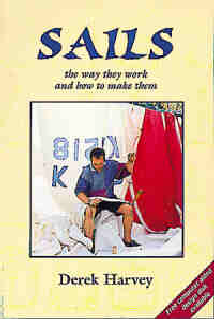
SAILS:
The Way They Work and How to Make Them
by Derek Harvey
This book is for the do-it-yourselfer. Derek Harvey will show you how to save up to three-quarters the cost of store-bought sails. Learn how to use CAD (computer aided design) which you can receive free with the purchase of this book, the origins of the different shapes of sails, the way they work, and the differences between them. He describes the way to choose the best cloth for your application; determining the size, cloth weight, and material. All the aspects for designing and repairing your own sails are covered in this book.
#255 Softcover, 6 1/8" x 9 1/4", 192pp, b&w photos and illustrations
…Eur 24,95
|


